Wednesday, 18 February 2015

London Art Buses


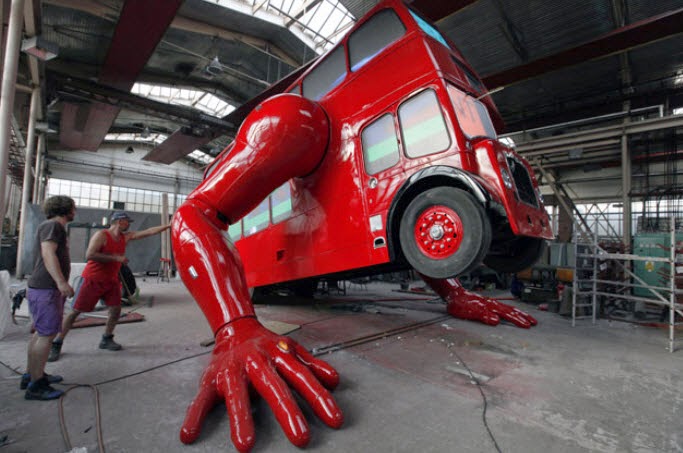
A London bus that has been transformed into a robotic sculpture by Czech artist David Cerny is assembled in front of the Czech Olympic headquarters in London.
By RFE/RL


The controversial Czech artist David Cerny has turned a British double-decker bus into an athlete doing push-ups in order to celebrate the Olympic Games, which open in London on July 27.

Cerny bought the 1957 Routemaster bus in the Netherlands. He attached two huge arms, an electrical engine, and a lot of wiring and suspension tools to make it into a piece he calls "London Booster."

The mechanics inside make the red six-ton bus move up and down on bright-red arms, raising the chassis into various angles. It is accompanied by recordings of a groaning voice and video projections in the windows.

read more: http://www.rferl.org/content/david-cerny...53527.html


===============================================================


London Art Bus Sculptures
Sculpture trails
Presented in partnership with Wild in Art, the Year of the Bus Sculpture Trails brought businesses and artists together to create a series of free and accessible public art sculpture trails across London in 2014.

You now have a chance to own one of the unique bus sculptures, based on one of London's newest icons, the New Routemaster. The funds raised from the auction will go to three charities - Kids Company, London Transport Museum and Transaid. You can read about the charities' work further down this page.

Painted and adorned by well-known and aspiring artists, the sculptures captured the imagination of Londoners and visitors to the city when they went on display on four walking trails across the Capital in 2014.

The bus sculptures have now been removed from their on-street locations and can be seen at Queen Elizabeth Olympic Park until Monday 23 February 2015.

You can place a bid until 12:00 on Tuesday 24 March 2015. Bidding will then reopen in parallel with the live auction at 19:00 on Tuesday 24 March 2015.

http://www.tfl.gov.uk/campaign/sculpture-trails


=============================================================


pictures source: http://www.demotix.com/news/6027938/bus-art-trail-launched-trafalger-square-london#media-6027278


2015 Cologne Carnival

2015 Cologne Carnival
Motto 2015 Cologne Carnival : social jeck – kunterbunt vernetzt


===================================================================


===============================================================


===========================================================

Tuesday, 17 February 2015

Patrick Nasmyth


A Landscape With A Cottage Near Dorking by Patrick Nasmyth


Patrick Nasmyth, (7 January 1787 – 17 August 1831), was a Scottish landscape painter. He was the eldest son of the famous artist Alexander Nasmyth, whilst his younger brother, James, was a prominent engineer who gained notoriety as the inventor of the steam hammer.[wikipedia]


Landscape with a Pond (1815)


Patrick Nasmyth, An Angler In A Wooded Landscape, oil on panel


Monday, 16 February 2015

Pancake Day 2015 is on Tuesday, February 17, 2015 - tomorrow!

Shrove Tuesday,  Pancake Day 2015 is on Tuesday, February 17, 2015 - tomorrow!

is a day in February or March, preceding Ash Wednesday (the first day of Lent), which is celebrated in some countries by consuming pancakes.

Shrove Tuesday, a moveable feast, is determined by Easter. The expression "Shrove Tuesday" comes from the word shrive, meaning "confess". Shrove Tuesday is observed by many Christians, including Anglicans, Lutherans, Methodists and Roman Catholics, who "make a special point of self-examination, of considering what wrongs they need to repent, and what amendments of life or areas of spiritual growth they especially need to ask God's help in dealing with."


http://outandaboutinthecity.com/tag/pancake/

British Pancakes 


Ingredients: 
1/2 cup Flour
1/2 cup Milk
1/2 cup Water
1 egg
Pinch of Salt
  • Throw all the ingredients into a bowl and mix. The batter will be a bit runny. Let sit for a few minutes.
  • Heat up a frying pan and melt some butter making sure it covers the entire surface.
  • Pour some batter (about 4-5 tbl) into the pan and spread it all over the surface but be careful not to make it too thin.
  • Let it cook and when it is brown on the underside side, flip it and cook the second side.
  • Remember the first pancake rule! It’s typically a dud. But soldier on and you’ll be enjoying these pancakes in no time.These pancakes are fun for including topings such as fruit and ice cream or fruit and cream or maple syrup. You typically role them up and then eat them with a knife and fork. This is not a burrito!


American pancakes
We’ve all seen enough movies to know that Americans like their pancakes and they like them with bacon. It’s a weird combo that I’m yet to try out. But perhaps they’re onto something. I’m not sure.


But perhaps this recipe will be perfect for giving the pancake and bacon thingey a try.
Ingredients:
1 cup flour
2 tbl sugar
2 tsp baking powder
1/2 tsp salt
  • Mix all these ingredients together
1 cup Milk
2 tbl butter
1 egg
  • Mix in a separate bowl and then add to the dry ingredients and mix again.
  • Heat the frying pan and melt some butter.
  • Drop 4-5 tbl of batter in the pan and cook. When bubbles form and pop, flip over and cook.
  • First pancake rule applies with American pancakes – so expect a dud.
  • Enjoy Canadian maple syrup on these babies.
source: http://outandaboutinthecity.com/tag/pancake/

bless his cotton socks


 Trading Hall, Liverpool Cotton Exchange, Old Hall Street, Liverpool, (1907)
Photographs by Bedford Lemere & Co 


The interior of the trading hall or 'exchange' in the Liverpool Cotton Exchange. The Cotton Exchange was built in 1906 to the designs of Matear and Simon, to provide a venue for the trading of imported raw cotton destined for the Lancashire mills. The finished goods were then, in turn, sold across the world through the Manchester Royal Exchange. The Edwardian Baroque frontage to Old Hall Street was demolished in 1967 and replaced with a modern office facade. 1907  Photographs by Bedford Lemere & Co


  The Cotton Exchange was purpose built in 1906 and once housed Liverpool’s thriving cotton exchange. There are reminders of its intriguing history to be found throughout, from the cotton emblems on Edmund Street to the old granite columns within some of the office spaces.

It acted as the centre of the cotton trading world, with telephones and direct cables going to the New York, Bremen and Bombay! The original ornate facade of the building was replaced in the late 1960's with Cotton House office space. The statues that once adorned the facade can still be found around the building. Navigation and Commerce sit in the courtyard, and a Portland Stone statue of Liverpool’s The River Mersey can be found on Old Hall Street.


========================================


A city built on cotton 

http://www.liverpoolmuseums.org.uk/maritime/exhibitions/cotton/traders/liverpool.aspx


Cotton Exchange © Liverpool Record Office, Liverpool Libraries
Liverpool has been shaped by the many people and places involved in the cotton trade.
Liverpool is a cosmopolitan city and the global nature of the cotton trade contributed to this. There were brokers from all over the world based here in the 19th century, including Germany, Prussia, Russia, Greece, the USA and India.
Many of Liverpool’s famous names were made from cotton, including the Rathbones and the Holts. Wealthy cotton merchants and brokers lived in fine houses. Many lived around Sefton Park in the late 19th century.
The cotton trade in Liverpool could not have functioned without the many others who enabled it to run smoothly. The dockers, warehousemen, carters, clerks and message boys were all vital. There is a popular myth that cotton bales were used in the foundations of the Liver building. This is probably no more than a story, but it shows how important cotton is to Liverpool’s history.

Why Liverpool?

Cotton was the largest and most important trade in the city, accounting for almost half of the imports and exports that went through the port.
In the 17th century, cotton came into Britain through London from the Middle East. In the 18th century, the new plantations in the West Indies, Brazil and America started to grow cotton. Liverpool had existing trade links with these areas, and so cotton began to arrive in the Mersey.
The first American cotton was unloaded in Liverpool in 1784. There were only eight bags. Less than forty years later, half a million bales were arriving each year from America. Other countries also supplied cotton, including Brazil, Egypt and India. By 1850, cotton accounted for almost half of the city’s trade. Over 1.5 million bales were imported.
The finished goods from Lancashire mills were also exported from Liverpool, accounting for almost half of the total exports in 1901.

Exchange Flags

‘The pavement was white with the fluff of cotton samples’
The cotton merchants and brokers met on Exchange Flags to do their buying and selling.
In 1808, an Exchange Building opened, but while cotton brokers took offices there, they preferred to conduct their business in the open square.
The cotton market continued to meet out of doors until the 1880s. The Flags were a place to meet and swap information about the cotton market. New technology like the telegraph and telephone played a major part in moving the cotton men indoors.
A purpose-built Cotton Exchange was commissioned and completed in 1906. This was a state of the art building, with telephones and direct cables to the New York, Bremen and Bombay cotton exchanges.

Exchange Flags, May 1886


source: http://www.liverpoolmuseums.org.uk/maritime/exhibitions/cotton/traders/liverpool.aspx


Why do we say: "Aw, bless his/her little cotton socks"?
Where did it come from and what exactly does it mean, why we say it and where it came from.


    George Edward Lynch Cotton was English clergyman and educator, assistant master at Rugby (1837-1852), the young master in Thomas Hughes's "Tom Brown's School Days". He was Bishop of Calcutta at 1858 where he did missionary work and established schools for Eurasian children.
In requests to England he asked for donations of clothing, often emphasizing "warm socks" for the children.
In fact he seems to have held the simplistic view that if the children had warm socks many of their problems, mal-nutrition, disease, racial prejudice, etc. could be easily solved.
Little old maiden ladies all over England spent their time knitting socks for Bishop Cotton and sending them off to India.
He blessed all items used in his schools, and many shipments would arrive labeled:  " Socks for Cotton's blessing" and reportedly even "Cotton's socks for blessing".
Cotton's socks easily became corrupted to cotton socks.
When the Bishop was drowned in the Ganges on October 6, 1866, a despatch was sent to the Archbishop to ask: 'Who will bless his cotton socks?'

Like everything else in England, the expression "bless his cotton socks" has a formidable history behind it. The original expression has quite a different meaning. It originated during the Great Cotton Glut that led to the Panic of 1788-1791 inclusive, when British investors discovered that a bale of American cotton cost less than a long pound of the home-grown stuff. Lord Onan Dipswyck, Chancellor of the Exchequer, was heard to remark pithily that "Cotton" Mather, one of the former colonies' leading exporters, had "run the demmed price so low it wasn't worth the trouble to spill your seed into the ground." Clergymen closed each service with a plea that the Almighty would "bless his [patron's] cotton stocks."

The phrase changed into its present form in 1848, when a printer's devil left a "t" out of the reprinting of the Book of Common Prayer. The fellow was flogged and turned out of the typecaster's guild, but the damage had been done, and the expression has been "bless his cotton socks" ever since.


The phrase is now a term of endearment for a child who has done something sweet. It is also a way of saying: thank-you. Due to its association with "sweet" children and bolstered by Cotton's simplistic views it is often used ironically, thanking someone in a position of authority for suggesting a benevolent, yet simplistic even childish view or solution for a difficult situation.

Sometimes just a humorous thank you like: " I'll dance at your wedding with bells on."


picture source: http://handmadebycarolyn.blogspot.co.uk


Sunday, 8 February 2015

Liverpool - old, rare photos


LIVERPOOL, England.—Liverpool, the second city and principal seaport of England, is situated on the right bank of the Mersey, three miles from the sea, and one hundred and eighty-five miles from London. The town was founded by King John in 1207, and its growth for several centuries was very slow. In 1840 regular steamboat communications were opened between it and New York, which, no doubt, established the modern pre-eminence of Liverpool. The importation of raw cotton from the United States forms the great staple of its commerce. The docks which flank the Mersey for a distance of seven miles, and give employment to thousands of workmen, are its most characteristic and interesting sights.


LIME STREET, Liverpool, England.—Situated on the north-east side of the River Mersey, near its mouth, stands the above city, extending for miles along its banks. Liverpool is noted for the magnificence of its docks, which are constructed on the most stupendous scale, and said to cover, including the dry docks, over two hundred acres, and fifteen miles of quays. Its principal avenue is Lime Street, represented by the above picture. The large building in the centre is the Terminal Hotel, of the London and Northwestern Railway, which starts from the rear of the building.


source: http://www.ajhw.co.uk/books/book484/book484.html#fig011


Location: Liverpool
Category: landmarks
Address: Odeon London Road, Centre-Town, L.3 - 1934


source: http://www.liverpool-city-group.com/cgi-bin/liverpooldb.cgi?db=liverpool&postcode=L.3&sb=17&so=descend&view_records=Go&nh=2